Felix On The Run

Live. Breathe. Run.

My Running Journey: A Series (Part 3) — January 27, 2020

My Running Journey: A Series (Part 3)

If you haven’t read Chapter 1 or Chapter 2, Click the link.

Chapter 3


Coach Soto


After I was done running in college, I continued to train solo and race competitively in Cross Country and Track. After about a year without having a team to train with I thought I’d try my hand at coaching. My former high school was actually looking to hire a Head Coach for the Cross Country and Track program. I sent in my resume to the Athletics Director, thinking I was perfect for the job. But to my disappointment, he turned me down; stating they were looking for someone a little older with more experience in coaching. It hurt for a little bit, but I moved on. I went on with life working and training. Until one day, a former college teammate of mine messaged me saying that his former high school was looking for a Cross Country Coach and asked if I was interested in having an interview. I accepted but didn’t think much of it. It was a small high school that my former college coach once coached at, but had since not made much noise as far as results.

So I went in for an interview, and I felt like it went really well. The Athletic Director liked me, and liked my training philosophy. Maybe 3 weeks go by and I hadn’t heard back from him. “I didn’t get it”, I thought. I was ready to move on when he gave me a call one day and said he tried getting ahold of me but somehow the message wasn’t received. He offered me the position! So here I am, 22 years old and beginning my coaching career. I was terrified and excited at the same time. All I wanted to do was share my passion of  running with others and guide runners to their goals.

I remember the first day I was scheduled to meet up with the team. I was a nervous wreck. What if they don’t like me? What if I can’t be a good coach? What if this…and that? I gathered up the courage to get out of my car and walk up to the group high school students. I introduced myself, told them about my past with running, what my philosophies were and answered any questions they had. At first, if you ever met me, I look younger than I am, so the students thought I was another student-athlete! I would end up getting that a lot during my coaching career.

My first year at the high school was a big learning experience. I basically tried to mimic the coaching that I had previous and tried to adapt it for my current athletes. Slowly I learned how hard it is to train so many individuals with different backgrounds, experience and drives. But I was excited to learn and grow into a successful coach. My first year I had one female athlete make it to the Cross Country State Championship and be the Top Female in our league. Track Season I had more athletes reach the Championship meets. As the seasons and years went on I was able to take Athletes to State and Masters/Divisional Championships every season/year. Our athletes were in the newspaper, named Top Runners of the year, Received multiple awards, Back-to-back Individual League Champions, State Qualifiers and the list goes on. I spent four years coaching the high school, and had felt like it was time to move on. Going into my second year of coaching the high school, my former college coach offered me an opportunity to take over the Men’s Cross Country and Track Distance Team. I would coach both the college and the high school for 2 years before stepping down as Head Coach for the high school to focus my efforts on the college team.

During my stent with the college team, I helped bring the mens Cross Country team to the State Championships, one of our guys win Conference; in Track had guys place in Sate, win Conferences and help many others improve their times. I learned a lot coaching at the college level. I learned what is needed and what it takes to be successful at this level. I felt like I had a lot more learning to do, and with my busy schedule with my full time job I found it difficult to dedicate the appropriate amount of time to the sport and to the team. So after 3 years of coaching the college, I stepped down because the future growth of the team is more important than my desire to coach it.

I am my own worst critic. There is a lot of things I felt like I should have done differently, things I should have done more of and/or less of. But it was a great learning experience. Now I am in a place where I train and coach others in their journey of running and their pursuit to greatness. I love the sport of running and I wish to share that passion with others. I have goals of once again coaching a collegiate team. And next time it will be different, I will give it everything I have, because the sport has given me so much, and I have shed so many tears and sweat for it. It’s time to give back.

Workout of the Day: VO2max — January 15, 2020

Workout of the Day: VO2max

Workout of the Day: VO2max Workouts

Want to know the secret to running a faster 5k? Incorporating VO2max workouts into your running schedule is a great way to improve your running economy, build mental toughness and get a PR!!!

What is VO2max?

An intensity of running that is associated with your maximum oxygen uptake capacity.

  • How efficient your body is at transporting and utilizing oxygen to working muscles to use as energy.

What are the benefits of doing a VO2max Workout?

  • Increases your bodies efficiency in using oxygen to fuel muscles; meaning, you can run faster and longer before crapping out.
  • A great way to get familiar with race pace, if goal race is between 3k and 5k.
  •  Great for mental toughness and lactic acid buffering.
    • Lactic acid buffering can be seen as you being able to desensitize yourself to the negative effects of muscle fatigue

What pace or effort level should VO2max Workouts be done at?

  • Defined as a pace between your PR 3k-5k Race pace
  • If training with Heart Rate, look to achieve around 95% of Max Heart Rate.

When and how often should you do a VO2max Workout?

VO2max workouts are very demanding and should not be attempted unless you have a solid mileage base under your legs. These kinds of workouts should be introduced around half way through your training season and sustained for the remainder of it until you begin to taper for a big race.

Because this type of workout is so demanding, you should perform a V02max workout only once per week; a 3k-5k race would take the place of the workout if racing during the week.

Different types/way to do a VO2max Workout.

    • Typical workouts include
      • Intervals lasting between 3-5 minutes
      • 800m-1200m Repeats at 3k-5k race pace with minimal rest (1:00 to 2:30)to maintain heart rate and time at VO2max
      • Can be shorter with minimal rest to break up the work load (400m repeats with 1:00 rest)

Example workout for beginners, intermediate and advanced runners.

Beginners: 8 x 400ms with 1:30 Rest; 4 x 800m with 2:30 – 3:00 Rest

Intermediate: 12 – 16 x 400m with 1:00 Rest; 6 – 8 x 800m with 2:30 Rest; 5 – 6 x 1k with 3:00 Rest

Advanced: 20 x 400m with 1:00 Rest; 10 x 800m with 2:00 Rest; 8 x 1k with 2:30 – 3:00 Rest; 4 – 5 x 1 Mile with 4:00 Rest

Final Thoughts

VO2max workouts are a great way to boost your fitness and lower your PR. Make sure you have a solid base of mileage before adding them to your schedule and perform them no more than once per week. They are going to be physically and mentally challenging, but that is what will make you a better runner. Be sure to get plenty of rest before hand and also make sure nutrition and hydration are taken care of both before and after the workout.

Good luck and have fun!

My Running Journey: A Series (Part 2) — January 5, 2020

My Running Journey: A Series (Part 2)

If you haven’t read Chapter 1, read it here.

Chapter 2


“Today Was Our Easy Run”


I was not prepared for the Summer of 2010. In high school, in hind sight, I did not have the level of training that my new teammates had. The longest run I had done up to that point was 5 miles, and I am confident I walked a lot of that. There was no way out of it now. I was with the big boys and had to put in the work if I wanted to succeed, or at least not fall behind.

I remember the first run I ever did with the team; it was not the best run I had ever had. We met up early in the morning on a Sunday for a long run at the famous Hawkins Road, an area surrounded by grape and almond orchards with big rolling hills. Everyone was set to run 10-12 miles that day. Coach Cuevas gave me a simple 8 miles, out and back. It was a cold morning so I was dressed in basketball length shorts, a shirt and heavy sweater. All my other teammates showed up in short shorts and took their shirts off before the run even started. I thought they were crazy. Little did I know, that I was the crazy one! That run destroyed me. I was burning up less than halfway through the run and had to take off my sweater and tie it around my waist. I had to stop a couple times to catch my breath and let my screaming muscles relax. When I got done with the run I felt like I made a mistake choosing to run in college with experienced runners as teammates.

But I stuck with it, all summer long I showed up every single day, and tried my hardest to run with this group of guys. I remember one run in particular that changed my whole focus. We were out for a simple 6 mile run. For some reason I felt it necessary to take off from the start of the run. I ran HARD. At the 3 mile turn-around point I had a gap of about 100+ meters on the group. I felt great! Then about 4 miles in I started to feel the fatigue from going out too hard. I slowly started to tighten up and my paced slowed down drastically. With less than 3/4 of a mile left in the run, all the guys flew passed me and I would eventually come in almost a minute after them. Gasping for air and hunched over, one of my teammates came up to me and said congrats on a good run, and I said “thanks, I did better holding you guys off this time around”. He put his arms around me and said “Yeah, not to burst your bubble or anything, but today was our easy run”. This shattered my confidence all at once. I just pushed myself as hard as I could and it was their easy recovery day and they wanted me to know that. Who was I? Who was I to think I could hang with these guys? To them, I didn’t belong there, I was too short, too heavy set and too slow to be on this team.

But I didn’t let it defeat me. Sure, I felt like shit but I was determined to prove my worth! From that moment on I made it a point to prove I belonged, I was capable, I WAS a runner! And Every single day I worked to run as fast as my teammates, to keep up in workouts, to be one of them. Slowly but surely I worked my way up to being a decent athlete. My teammates then acknowledged that they had little confidence in me at first, but that they were impressed and proud of me. I improved my race times drastically. My fitness was the best it had ever been. And I worked hard. Sure, other were still faster than me, but I was right there with them, I could hang on for 10,12, 16 mile long runs. I fell in love with the sport and wanted more out of it. As time went on, I was one of the upper class men who was teaching the newer guys how to work hard, how to be consistent and dedicated. This slowly started to become a thing where I would help other runners in their workouts, talk them through rough patches and push them to be a better runner. This was the start of the next part of my life…Coaching.

MJC Squad

My Running Journey: A Series (Part 1) — December 2, 2019

My Running Journey: A Series (Part 1)

Chapter 1


The Warm Up


My father was a decorated runner in his time. As a sophomore in high school he was already setting course records and winning varsity chamiponships in Cross Country and Track. Growing up in San Jose, California in the 1960’s and 70’s and one of eleven children, sports was a way of keeping his siblings and himself out of trouble. Til this day my dad says he wishes he tried harder, because to him, he never felt challenged. Coming from someone who ran a mile in 4:20 and 5k in the 14 minute range, that’s hard to compete with, and I’m his own son!

So I guess you can say running was in my blood, no matter how hard I tried to run away from it. Pun intended. I remember going to my grandmas house and seeing all the trophies, plaques and medals my dad had won over the years. Boxes full of medals that couldn’t fit on the shelves that probably was one medal away from collapsing. He would tell me how he would tell the T-shirt booth to save him a shirt in his size because he knew he was going to win that day.

Although my father was a talented runner, he never pushed me to the sport. In hind-sight I wish he had. As I went through my rebellious teen years, my attempt to tryout for football, even trying out for the sprints; he never pushed me to do anything I didn’t want to do.

Spring my junior year of high school, a good friend of mine, Juan, was pushing me to join the schools track team. After countless efforts of trying yo convince me, I caved and told him I’d attend one practice. The coach put Juan and myself on the track and told us to race one full lap around the track. Now, I have always been quite competitive when it came to anything sports related, especially running, I mean, it was in my blood for goodness sake! So I took up the challenge. We were no more than 100 meters into the race when I gassed out and couldn’t keep up with Juan as he strode to the finish line with a great big smile on his face. Me, gasping for air with my hands on my knees, the coach came up to me jokingly saying, “You’re going to have to train a lot if you ever want to beat him (Juan).” Right then and there I was hooked, without even knowing it. I wanted to be faster and I wanted to beat Juan.

So Junior year I joined our schools track team as a sprinter in the 100m, 200m, 400m and 4 x 400m team. Let me say what you’re probably already thinking. “But wait, I thought you were a distance runner!?” Yes, that is true, but back then I was naive…and quite slow. Turns out, sprinting was not in the cards for me, I was just too big and too slow to ever compete with the rest. (This is something that comes up again later in my running career.) So the same friend who convinced me to join track in the first okay, Juan, told me that I should run Cross Country in the Fall to get in better shape once Track cam around. I decided to tale him up on the offer and join Cross Country so I could finally beat him in the 400m the next year. Little did I know, running Cross Country was about to change my whole life.

In the Fall, I joined the Cross Country team and had a rude awaking when I discovered that I would have to run more than 400 meters…a little more than 12 times the amount actually! Going from doing 100m repeats to 3-5 mile runs and repetitions of 800m or more was something I definitely did not expect. If I’m honest, I walked a lot, I cut runs short often and I more time than not ran too fast and burned out on my runs and workouts. Once I got settled and figured out how to run the distances, I started enjoying it. The racing though was another story, 5k races on dirt, grass, hills and gravel was a completely different world from the world of track I knew.

Long story short, I ended up becoming our #2 guy. I was liked! I had lost some weight, I had gotten more fit and was ready for track so I could redeem myself in the sprints. But my coaches had other plans for me. I remember having a pre-season meeting with my coaches and they had asked me what my goals for the season were, to which I said “I want to run the 200m and 400m.” Very bluntly the said “Nope, you’re running the 800m, 1 mile and 2 mile for us.” I was shocked and confused. “No, I’m a sprinter though.” Again, very direct, my coach said “mmm…no you’re not, you’re a distance guy now.” I mean, how could I argue that. If my coach wanted me to run distance then I guess I’m running distance.

So I ran. And I did pretty good too. I remember going into our first league race and I was set to run the 1600m. I remember setting a goal for myself. I said I’d be happy if I can run in the 5:20’s. I had no idea what a fast time was and I though 5:20 sounded like a good time to run for the first time. When the gun went off, all I knew was sprinting, so I took off as fast as I could and paid the price for it later. Never in my life had I felt so much pain in my arms and legs before. Cross Country was a slowly creeping pain, where as track was more of a sudden influx of lactic acid that causes your whole body to want to shut down. But I finished the race, not sure at how I did. When I saw my time I was surprised; 5:04. I thought to myself “Oh my god, maybe I am pretty decent at this distance stuff. What if I can run a mile in the 4 minutes!” And so the grind was on. At my best I would run 2:09 in 800m, 4:46 in 1600m and 10:31 in 3200m.

I would have said I had a successful first year of distance running. Now during my whole high school tenure, I had no real ambitions to attend college. It wasn’t until I was approached by who would be my future college coach at my High School League Championships where I would be asked to join a Junior College Cross Country and Track team. I was surprised. I mean, sure I ran decent times for a first timer, but there were kids way faster than me. But nonetheless, I accepted and I would start my journey as a Modesto Junior College Pirate! Life would never be the same after that.

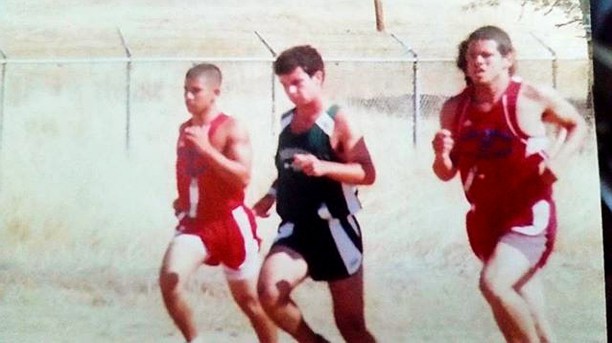
Flashback cross country race at frogtown


Read Chapter 2 “Today Was Our Easy Day”

Recovery IS Training — October 30, 2019

Recovery IS Training


rest break on the track

Let’s talk about recovery! Now, I know that this can be a touchy subject for some. I mean, why would anyone want to take time off or ease off of their training when it’s going so well?! What’s the point of recovery? What if I lose fitness because I recover too much?

First off, it’s ok to take some time to slow things down and let your body recover. Especially if you train 5-7 days a week for months on end. You have to remember that recovery IS part of training. It should be planned and scheduled just like any workout you do during your training. Whether it’s taking planned recovery days between hard training sessions, or taking time off completely once you’ve completed your goal race or your “season” is over.

Hopefully todays post gives you some peace of mind and promotes a healthier outlook on recovery.

Now, let’s dive in!

What is recovery?

Recovery is anytime you decrease your training load and/or intensity to promote muscle and other soft tissue recovery. When you train, you stress the muscles, joints and tendons in your body. After an intense workout your body is quite a bit broken down, so it needs a couple days to rebuild. During this time your muscles compensate by becoming stronger so the next time that workout is attempted it can handle it a bit better. Recovery doesn’t necessarily mean you need to stop training all together; just take it easy to let your body catch up.

What are the benefits to recovery?

Number one, you allow your body to rebuild. When you do hard training session your muscles get pretty beat up. Some easy training sessions for the next 2 – 3 days after allows your muscles to heal and get stronger.

Secondly, It’s to help prevent mental fatigue aka Burning out. When all you do is train train train, and never take time to slow things down, you become burnt out. You start to lose motivation because your body is always tired, muscles are always aching, your paces are slowing down and you are just no longer enjoying yourself.

Lastly, recovery helps reduce the likelihood of getting injured. Sometimes when you push too hard and don’t take the necessary steps to recover, you leave yourself susceptible to injuries.

What are the consequences of skimping on recovery?

Not scheduling recovery days between hard efforts or training hard 365 days a year can cause your performance to suffer. You may get injured, become burnt out and never reach your potential. When you train too hard too often you weaken your immune system as well, meaning you get sick more often, thus loose out on training.

How to recover.

This part might be easier said than done for some. But the reality is, you need recovery.

Here are a couple ways to include recovery into your training;

  1. Plan recovery days after a hard workout or race. The 2-3 days after a race or workout lower the intensity and/or volume of your training.
  2. If you spent 4-5 months training for a goal race, once you have completed that race, take 1-2 weeks off of no training. This is great for a mental reset so that you come back into training with a hunger to get back into it, and it allows your body to heal all the aches and pains that you training through.
  3. If you are having trouble planning recovery days and need more help, get in touch with a coach that can help guide you. I have Coached Cross Country and Track and Field at the High School and Collegiate level, and one thing I know for sure is that many athletes take recovery for granted and tend to over do thing.

Summary

Take some time to slow thing down and relax. If you plan accordingly, your body will recover better, you will get stronger and faster, and you will enjoy training.

If you have any questions about Recovery or want to know more about having a Personal Running Coach, message me or leave me comment below. Enjoy your training, and don’t forget to recover after!